
But have you ever wondered, how many i-adjectives are there?
And how many な na-adjectives?
How many な na-adjectives end with い (i) sound?
Let’s look into that.
We analyzed our data source and here are the stats:
| Count | Percentage | |
|---|---|---|
| na-adjectives | 6027 | 69.38% |
| i-adjectives | 2660 | 30.62% |
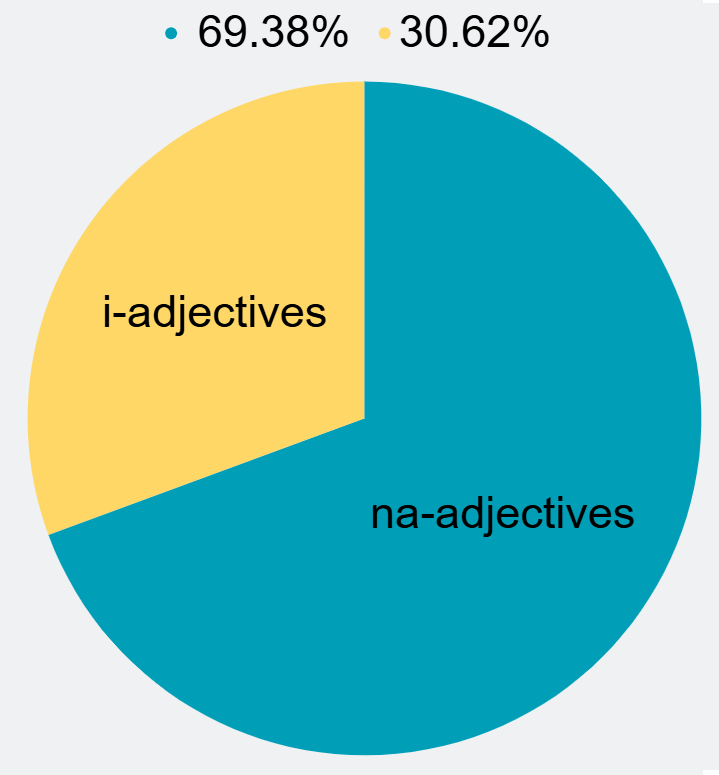
As you can see, na-adjectives are more common - being 69.38% of all Adjectives.
i-adjectives take up the rest - 30.62%
Do i-adjectives always end on い (i)?
| Count | Percentage | |
|---|---|---|
| i-adjectives ending with い (i) | 2660 | 100% |
| i-adjectives with different ending | 0 | 0% |
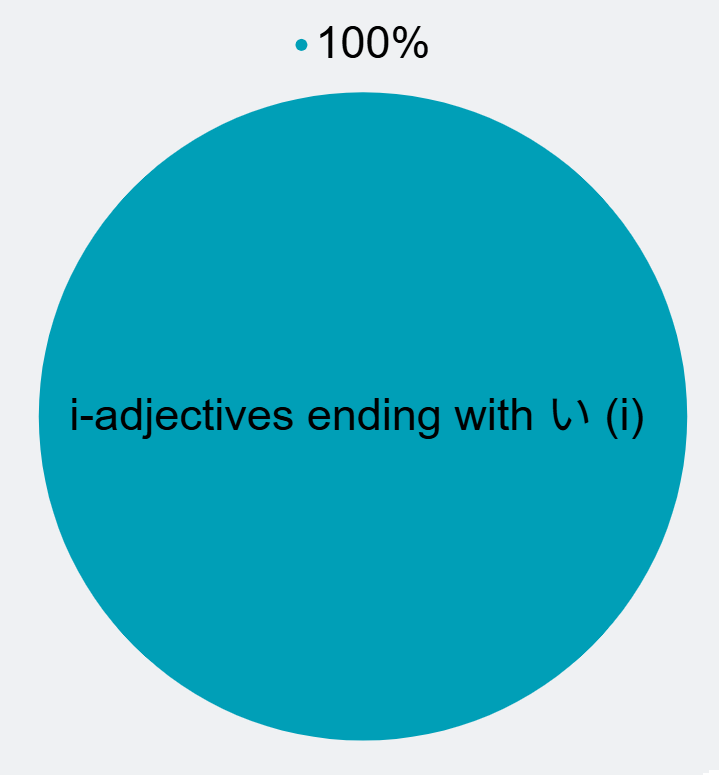
Short and sweet - YES - 100% of i-adjectives end with い (i).
No exceptions.
Na-adjectives are a bit more tricky - some of them end on い (i) sound and therefore may sound like i-adjectives.
How many, you ask?
| Count | Percentage | |
|---|---|---|
| na-adjectives NOT ending with い (i) | 5404 | 89.66% |
| na-adjectives ending with い (i) | 623 | 10.34% |
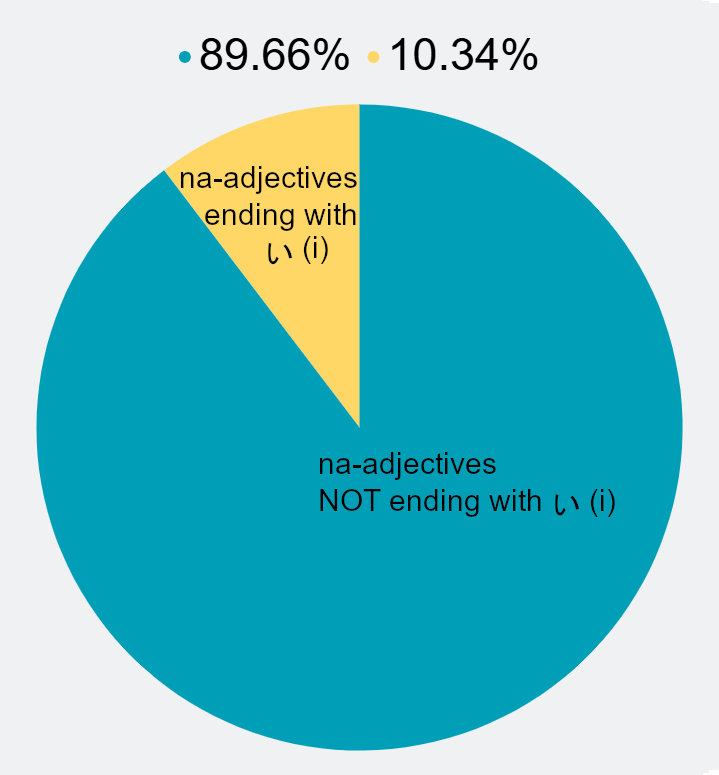
na-adjectives ending with い (i) take up about 10% of all na-adjectives.
To combine, adjectives from both groups that end on い (i):
| Count | Percentage | |
|---|---|---|
| i-adjectives | 2660 | 78.39% |
| na-adjectives ending with い (i) | 623 | 21.61% |
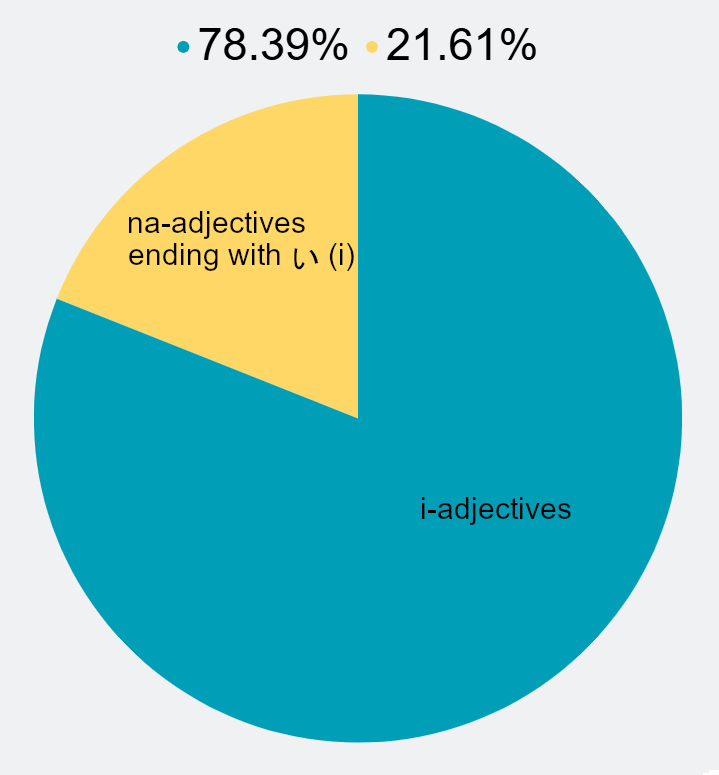
You can see that 78.39% of all Adjectives ending in い (i) are i-adjectives.
Only little more than 21% are na-adjectives.
If you encounter an adjective ending on い (i) and you have no idea in which group the adjective belongs to, you can try betting on い (i) adjective group.
You may still be wrong, of course, but you have higher chance of being right.
Disclaimer:
These statistics do not precisely reflect the whole language! Consider all numbers to be approximate!
As mentioned before, we analyzed our data source - JMdict-EDICT Dictionary Project to create these statistics.
The data source does not cover all existing words and may contain errors.
Language is like a living organism, it evolves and changes over time.