
Little intro
As you probably know, there are 3 main groups of Verbs in Japanese. They are called differently in different sources:
| 1. | Godan (五段) | Group 1 (動詞 1) | Group I | U Verbs |
| 2. | Ichidan (一段) | Group 2 (動詞 2) | Group II | Ru Verbs |
| 3. | Irregular Verbs (不規則動詞) | Group 3 ( 動詞 3) | Group III |
Ichidan Verbs always end with る, Godan Verbs can have different endings, including る.
Furthermore, Ichidan Verbs always end either in -いる or -える sound.
Some Godan Verbs can also end with -いる or -える sound.
If you’d like to learn more about Godan Verbs and their conjugations check out this post
So, how many Ichidan and how many Godan verb are there?
We analyzed the data source we use in our dictionary and here are the statistics:
| Count | Percentage | |
|---|---|---|
| Godan | 11149 | 67.21% |
| Ichidan | 5438 | 32.78% |
| Irregular | 2 | 0.01% |

Ichidan Statistics
Let’s look at Ichidan Verbs more closely:
| Count | Percentage | |
|---|---|---|
| Ichidan with -いる / -える ending | 5438 | 100% |
| Ichidan with different ending | 0 | 0% |
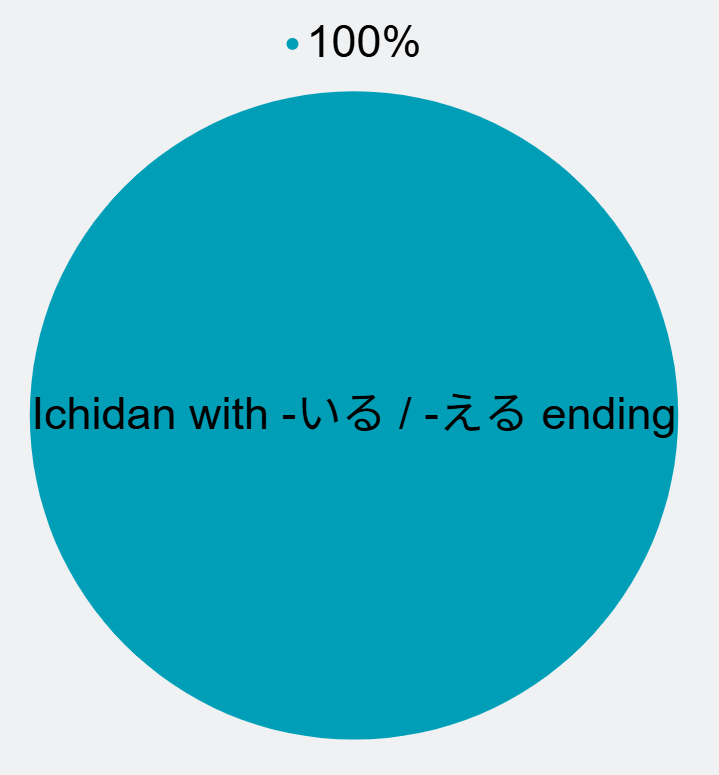
Out of 5438 Ichidan Verbs there are NO exceptions to the -いる / -える (-iru / -eru) ending rule.
Nice, isn’t it?
From the 5438 Ichidan Verbs:
| Count | Percentage | |
|---|---|---|
| -える (-eru) ending | 4834 | 88.89% |
| -いる (-iru) ending | 604 | 11.11% |

As you can see, -える (-eru) ending is much more common, in fact it makes 88.89% of all Ichidan Verbs.
The rest, 11.11% being those with -いる (-iru) ending.
Godan Statistics
Let’s dive into Godan Verbs:
| Count | Percentage | |
|---|---|---|
| Godan with other endings | 10440 | 93.64% |
| Godan with -いる / -える ending | 709 | 6.36% |

As you can see, only about 6.36% of Godan Verbs end on -いる (-iru) / -える (-eru) sounds and therefore may sound like Ichidan Verbs.
Majority - 93.64% end with different sound.
Out of the 709 Godan Verbs ending in -いる (-iru) / -える (-eru):
| Count | Percentage | |
|---|---|---|
| -いる (-iru) ending | 557 | 78.56% |
| -える (-eru) ending | 152 | 21.44% |

Notice that with Godan Verbs the -いる (-iru) ending is in majority, unlike with Ichidan Verbs.
78.56% end with -いる (-iru) and only 21.44% end with -える (-eru) sound.
Godan vs. Ichidan with -いる (-iru) ending
Statistics for verbs ending with -いる (-iru) sound are:
| Count | Percentage | |
|---|---|---|
| Ichidan | 604 | 52.02% |
| Godan | 557 | 47.98% |

As you can see, there are slightly more Ichidans ending with -いる (-iru) sound, but only about 2% more than Godans.
With -える (-eru) it’s quite different…
Godan vs. Ichidan with -える (-eru) ending
Statistics for verbs ending with -える (-eru) sound:
| Count | Percentage | |
|---|---|---|
| Ichidan | 4834 | 96.95% |
| Godan | 152 | 3.05% |

Ichidans are dominating the -える (-eru) endings, being total of nearly 97% of all verbs with this ending.
So if you encounter a verb with -える (-eru) sound and you are not sure if it’s Ichidan or Godan, statistics suggest to guess Ichidan.
Godan Endings
While we’re at it, let’s explore the other endings as well:
| Count | Percentage | Examples | List of common used examples | |
|---|---|---|---|---|
| る (ru) | 3792 | 34.01% | 作る, 売る, 切る | Link |
| す (su) | 2864 | 25.69% | 出す, 回す, 示す | Link |
| く (ku) | 1540 | 13.81% | 行く, 引く, 開く | Link |
| う (u) | 1161 | 10.41% | 払う, 歌う, 買う | Link |
| む (mu) | 993 | 8.91% | 読む, 楽しむ, 休む | Link |
| つ (tsu) | 396 | 3.55% | 待つ, 持つ, 立つ | Link |
| ぐ (gu) | 214 | 1.92% | 泳ぐ, 濯ぐ, 次ぐ | Link |
| ぶ (bu) | 176 | 1.58% | 遊ぶ, 偲ぶ, 呼ぶ | Link |
| ぬ (nu) | 13 | 0.12% | 死ぬ, 往ぬ, 氏ぬ | Link |

As you can see, る (ru) rules the Godan Verbs - taking 34.01% of all endings.
The least common is ぬ (nu) with only 0.12%.
Irregular Verbs
Irregular Verbs get a bit complicated to define.
Most sources consider only する (suru) and 来る (kuru) to be truly irregular.
Some mention also the copula だ (da) and polite です (desu) together with the verb ある (aru) as somewhat irregular.
Also there are few exceptions of conjugations in polite forms (e.g. いらっしゃる -> いらっしゃいます).
Since there is no consensus, we do not consider there to be truly irregular and our statistics are counting only the する (suru) and 来る (kuru).
Therefore, since we count only 2 verbs to be truly irregular, it makes just 0.01% of all verbs.
Disclaimer:
There statistics do not precisely reflect the whole language! Consider all numbers to be approximate!
As mentioned before, we analyzed our data source - JMdict-EDICT Dictionary Project to create these statistics.
The data source does not cover all existing words and may contain errors.
Language is like a living organism, it evolves and changes over time.